
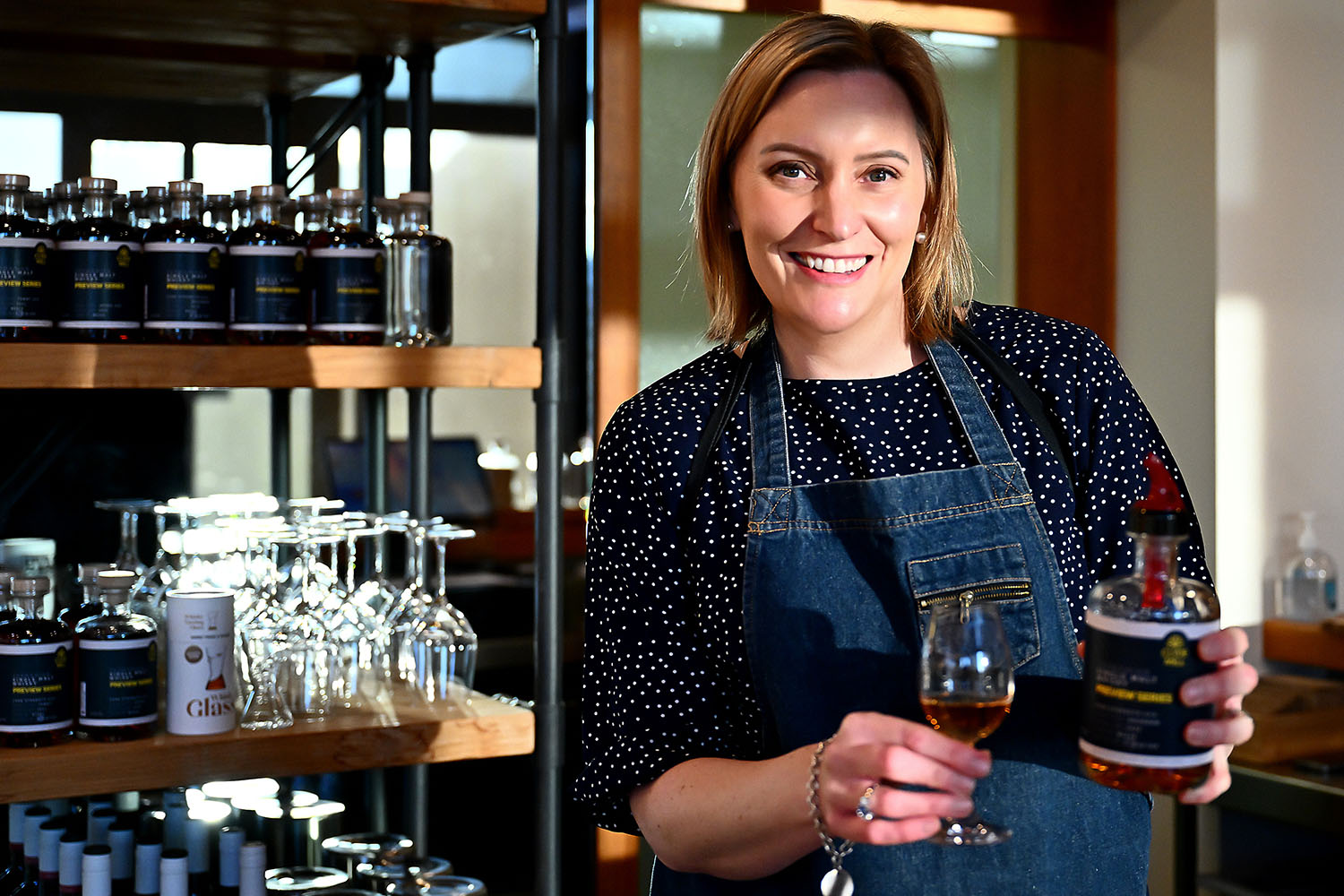
We’re thrilled to share this inspiring feature from The Mercury’s Weekend edition, where our story of transforming the historic Nant Distillery into Clyde Mill – a vibrant community hub in Tasmania’s Central Highlands – takes centre stage.
A huge thank you to The Mercury and journalist Bridget Clarke for capturing the passion, grit, and local love that’s fueling our revival. Dive into the full article below and discover how family, whisky, and Bothwell’s unbreakable spirit are blending into something truly special.
When Annie and John Ramsay bought the former Nant Distillery in the heart of Bothwell, they weren’t just bringing a whisky estate back to life – they were reigniting a community hub. Now, under its new name Clyde Mill, the couple’s vision blends craftsmanship, family and country spirit in Tasmania’s Central Highlands.
For people living and raising families in small country towns, “community” is not a buzzword but a way of life. It’s what intergenerational farmers Annie and John Ramsay most love about residing in Bothwell – a tiny town of around just 500 souls situated in Tasmania’s Central Highlands.
About an hour’s drive from Hobart, Bothwell is a typically bucolic setting, filled with sandstone Georgian houses set against the backdrop of lush green hills and glistening lakes. In times gone by, it was the kind of place Hobart locals went for an impromptu long lunch, having been the home of once acclaimed Nant Distillery and Estate. For reasons that have been previously well documented, Nant closed almost a decade ago, but the beauty of the site and the sense of community it brought were never forgotten by its regular visitors.
With their four children, the Ramsays considered themselves fortunate to live next door to it; the proximity inviting frequent peeks over the fence, each one filled with quiet anticipation for the day it might finally be listed for sale. So when it did eventually come on the market, it seemed only right the seemingly endlessly effervescent and civic-minded couple would buy and restore it. The Ramsays settled on the property earlier this year – and celebrated the relaunch of the old estate and distillery under the name Clyde Mill – in September. But the big question remains: what motivates a couple with four children and full-time jobs to buy, rebuild and operate a forgotten whisky distillery? “We were probably a bit naive heading into it, and I’m pretty impatient so I want everything done yesterday,” John says. “But the stars just aligned for us.”
The Ramsays met in 2005, when Annie was attending university in Launceston. Farming is deeply embedded in both of their family histories – Annie’s was based around Bream Creek and Buckland, while John himself grew up in Bothwell as part of the well-known Ramsay family, who are the owners and operators of Ratho Farm. “I promised I would never marry a farmer,” Annie laughs, prompting a retort from John: “I’m a pretty appealing character.” Upon finishing university, Annie moved to Bothwell with John. They married in 2009 and have since had four children – Alex, Henry, William and Matilda – all of whom went to primary school locally. It was important for generational sheep farmer John, who is always keen to extol the virtues of country living. “We love it,” John says. “There’s a really good community here, kids are similar ages. The older boys now work on the farm, driving tractors, or buggies and moving sheep. It’s a good lifestyle, being a farmer with kids.” “Living in a small community, people know each other, they support each other,” Annie adds. “It’s well known that people in rural communities can often struggle with their mental health, so having a place to come together as a community and for it to be affordable is really important”. The sentiment speaks to why they were keen to take on the mammoth challenge of breathing new life into the old Nant Estate. Perched on the banks of the historic Clyde River – now serving as the venue’s namesake – the estate had everything they believed was required not only for a community meeting spot, but also to accommodate their young family. “We’d obviously been to the estate before when the [Nant] distillery was running, and it was a wonderful place for the community and for people to go to. And so the bones of that were still there,” Annie says. “It ticked a lot of our boxes of having extra land, water and a lovely old homestead that meant we could move in with our family because it was big enough to fit us all, and then it just so happened to have a whisky distillery.”
As it stands today, Clyde Mill is everything you’d expect of a regional Tasmanian tourism destination. The distillery produces premium small-batch spirits including single malt whisky and a signature Highland Gin, while the restaurant’s menu champions a paddock-to-plate ethos, offering a repertoire of hearty meals including such dishes as confit duck with a cassoulet-style stew of butter beans, woodland mushrooms and vegetables and a local venison pie with mash topped with a whisky cream sauce. They also offer tours of the estate, including the preserved flour mill, around which the property was first established. Yet the true jewel in the crown is the view: sweeping emerald fields where spring lambs frolic, impeded only by the river that winds through the landscape and the historic stables and sheds that border the exterior. It is a beautiful, pastoral scene of a slick operation that like all Tasmanian venues of their ilk, punches above its weight. But despite the estate’s specs, getting to this point was needless to say, a challenge. “I think we realised very quickly that there was so many more people that were needed,” Annie says. “A lot of the time I think it’s just been about surrounding ourselves with the right people and acknowledging where our skills were, but we were so lucky to be surrounded by people who were willing to pitch in and give us a hand.”
The renovation process was a full community affair: a local builder led the project, while family members also pitched in – including the Ramsay’s own children. “They’ve each got their little jobs … but they’re probably getting to the point where they’re a little bit sick of it,” Annie laughs. “A lot of time out there they’ve been helping tidy things up, designing menus and sampling things, collecting the cans to recycle them. Our eldest has also been cleaning glasses and learning to wait tables.” But even with their children’s help – as well as assistance from other family and community members – balancing family commitments, ongoing renovations and their full-time jobs – Annie’s as a nurse at the Calvary Hobart Hospital and John as a farmer – proved overwhelming at times. “It’s been pretty hectic,” John says, candidly. “We’ve got an au pair to help with the kids, and we’ve got a really good farm manager here who’s been looking after the farm. I still felt very functional on the farm, but have had to take a fair bit of time out to make sure Clyde Mill is up and running.” Both agree that the biggest learning curve of them all came with the whisky side of things. Involving numerous stages from malting to mashing, fermenting and distilling to packaging and marketing, whisky distilling is a notoriously difficult process. It requires time, precision and the kind of specialised knowledge that can only really be built up over years of experience. Luckily for the Ramsays, it is a practice that over the years, has become part of the fabric of regional Tasmania – meaning help was never out of reach. “Dealing with the whisky element has been mostly about putting the right people in the right places, which makes things easier,” John says.
Among those figures were whisky aficionado Mark Nicholson, who offered counsel in the early stages of production; Anthony White, operator of Kingston’s White Label Distillery and “a good Bothwell boy” with past experience working with the Ramsays as a farmhand, and John’s own brother, Greg. “Greg’s been involved in the whisky industry for a while so had some connections. He did some introductions and then from there people were so willing with their time and reached out and offered to help,” Annie says. “Although the distillery had been there for a few years, it hadn’t been used or some time, so there were a number of things that needed fixing. We’ve had our distiller, Anthony [White], helping us, but you also need specialists – an electrician, someone for water testing and quality, and of course experts in sourcing barrels and deciding what kind to use. “Anthony’s taken a lot of pressure and responsibility off keeping the cellar door open, and Jayne and Andy, who are managing the Mill Kitchen are doing a sensational job … but there’s been a lot involved in getting everything back up and running.”
Despite their lack of knowledge around the technical process of whisky-making, the Ramsays were immediately able to recognise its value, bolstering heir resolve to make the Clyde Mill vision a reality and become a key player in Tasmania’s market. “Everyone speaks really highly of the whisky that was made on site for a different reasons,” Annie says. “Bill Lark, who had a big involvement in setting up the distillery, also talked about the Highlands as being a wonderful climate for maturing whisky. Because of all of that it seemed silly to not to make that decision to move into that space. “We’ve sourced some whisky from Lark Distillery that was actually distilled on site, which was really important to us – to have that genuine connection to the place. It’s whisky that was made in Bothwell, and it’s really, really good whisky. So having that locally made product was a key factor in our decision.”
The support they received from the industry itself also proved invaluable. “We’ve just found over this process that the whisky industry is so supportive and willing to help everyone out,” Annie says. “Even though you’re competing with each other in the market, everyone has just been really willing to share their knowledge and what’s worked for them and what hasn’t.”
As if to affirm their credentials as both a gin and whisky distillery, the venue was featured as part of Tasmanian Whisky Week, exclusively opening its doors offering whisky tastings, accompanying nibbles and site tours. It came ahead of their official opening in September, which understandably, came with both immense excitement and relief.
“We’ve had really great local support from people just popping in for a drink or some coffee and cake, or whisky, to friends and family who have been out and been able to enjoy the site,” Annie says. “It’s also been amazing to receive so much support from local businesses that have a connection to Bothwell, through working really closely with us and booking events.” But the work is far from over. Alongside renovating their own historic sandstone homestead – which they hope to move into by early next year – the Ramsays plan to expand existing facilities for larger gatherings like weddings, introduce on-site accommodation and marquee spaces, as well as enhance their distilling output, all with the aim of cementing themselves further as a premium tourism and events destination. “The point of difference with Clyde Mill is that yes we make great whisky, but people can also just come and enjoy the site and have a wonderful experience,” Annie says. “You go there and you can just enjoy this beautiful property, and learn and appreciate the history that both the community and the property have.”
But for now, they are savouring the company of the community that supported them so fiercely through the process – including through events like “the Monthly Muster”. “We had our first event this past Saturday where we had a barbecue and then at four o’clock a family was nominated to do a toast. So the bell rings, you do the toast and everyone has a dram of whisky or a gin or soft drink and it just … encapsulates that community piece that we’re so passionate about.” It’s moments like these that remind the Ramsays of why they embarked on the journey of restoring Clyde Mill. It also affords them a rare moment of respite to truly appreciate what they’ve created – to enjoy the sense the accomplishment, reflect on the lessons they’ve learnt, and look ahead with excitement at what’s to come.
“We’ve had quite a few pinch yourself moments,” Annie says. “We’re really proud and grateful to be on this journey, and we’re so excited about what the future holds for the site and for whisky, and for what that might mean in terms of being part of this wonderful industry that Tasmania has.” “This whole process has really shown me that people want to help out,” John adds. “I think even when they know it’s a huge punt for us, everyone wants to see it succeed. “To see the goodwill and generosity of the community has been really something. It’s been really, really nice.”
There’s more to drinking whisky than simply pouring a dram
We’re thrilled to share this inspiring feature from The Mercury’s
By Simon McGuire from Tasmanian Country 04 Sep 2025 Nant